

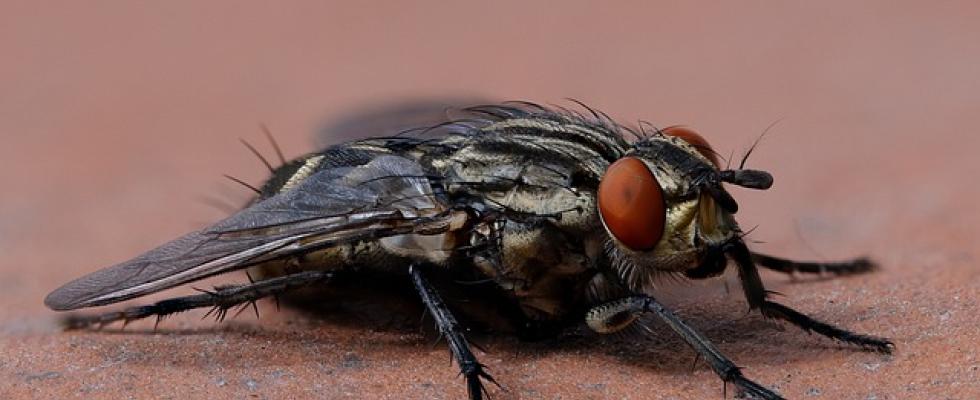
A parasitic fly could soon pose a risk to California’s public health and food supply.
This month, the California Department of Public Health (CDPH) issued an advisory regarding the New World Screwworm (NWS) fly. The bug's larvae bury into flesh and feed on living tissue. While it primarily poses a threat to livestock, the insect can also attach itself to pets or humans.
NWS has not yet been detected in California, but officials believe it’s only a matter of time. The insect was once eradicated from North America, but has recently spread northward from Panama into parts of Mexico.
“NWS may be directly introduced to California via an infested traveler or animal, or by continued spread of the NWS fly across Mexico and eventually into California,” the advisory said. “Since NWS introduced into California could propagate and spread, rapid identification, investigation, and communication will be critical for an effective response. CDC recently confirmed NWS infestation in a U.S. resident who recently traveled to El Salvador, but NWS has not otherwise been detected locally in the United States in humans, livestock, other animals, or in the environment.”
The U.S. Department of Agriculture (USDA) is closely monitoring the situation. USDA has called NWS “a threat to our food supply and our national security.” The economic cost of a NWS outbreak could total billions of dollars. Rural areas could be disproportionately impacted.
To protect ranchers, the USDA suspended imports of live cattle, horses, and bison from the Mexican border in May. Meanwhile, the government is trying to ramp up sterile fly production. This is a biological insect control technique in which sterile flies are released into the wild to mate and reduce successful procreation.
If and when NWS arrives in the U.S., early detection and action will be key. CDPH has published a series of recommendations for health care providers, local health departments, laboratories and travelers, which you can read here.
When traveling to an area where NWS is present, people should ensure that any wounds are kept clean and covered. They should also monitor themselves for signs of myiasis (parasitic infestation by fly maggots). Areas of risk include the Mexican states of Campeche, Chiapas, Oaxaca, Quintana Roo, Tabasco, Veracruz, and Yucatán.
Symptoms of myiasis from NWS include painful skin sores or wounds that have trouble healing, a feeling of “movement” under the skin, or a foul-smelling odor coming from a wound.
Healthcare providers who identify myiasis in a patient should ask about recent travel and notify their local health department, which should immediately notify CDPH. NWS larvae, whether suspected or confirmed, should never be discarded in the trash. Maggots should be placed in a sealed alcohol container of least 70% ethanol and be treated as biohazardous waste.
Suspected NWS infestation in any non-human animal must be reported immediately to the California Department of Food and Agriculture.
Read more from CDPH.